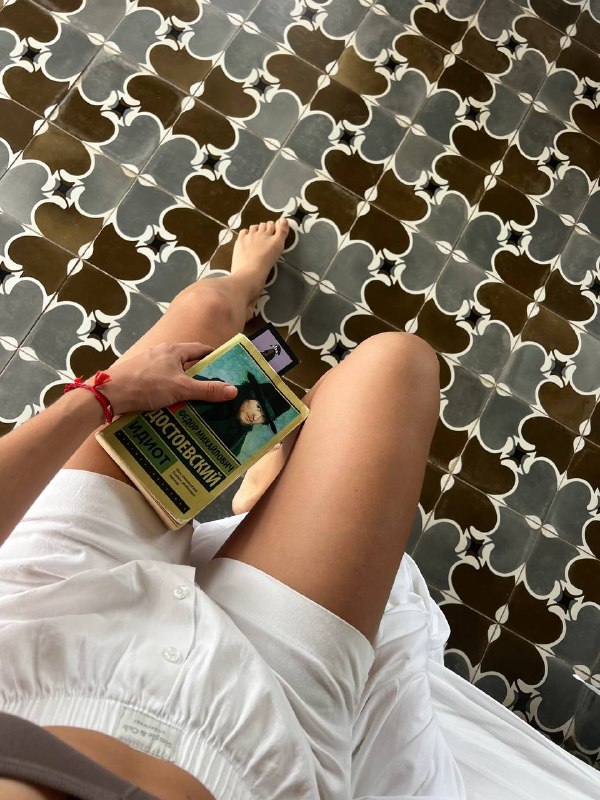
The Idiot: An Initiation into Dostoevsky
How I spent more than three months reading The Idiot—and why
At school, of course, we studied Crime and Punishment. Later, as an adult, I read The Brothers Karamazov. All I was left with was bewilderment. I understood absolutely nothing in these iconic works.
This year, instinct led me to The Idiot. I had started it a couple of years ago and promptly abandoned it. This time, however, it became an adventure—an initiation into Dostoevsky, you might say.
I allowed myself not to rush: I listened to lectures alongside the novel and took time to grasp its essence. I knew that Dostoevsky’s storytelling was nonlinear, that its moral was not predetermined, and that the line between good and evil was anything but clear.
Dostoevsky is a small, dark door leading into the deep basement of human nature. I wanted so much to understand every intricate meaning and perhaps find an answer that might heal something in me.
Even now, after many hours of discussions with AI, I feel I have absorbed perhaps thirty percent of the novel. That only makes the prospect of returning to it later more enticing.
So what do I have at this point? Where has it brought me?
“You feel a great deal of contempt now, don’t you think?
For what? Because you have suffered, and still suffer, more than we do?
No, because I am unworthy of my suffering.” (source)
Suffering as a form of inquiry.
This is not about suffering in order to grow. It is about suffering as a condition in which the whole truth about a person is laid bare. And it does not necessarily change you for the better. You can suffer and remain bitter and resentful. But there is also the path of acceptance—and, through it, a path towards understanding depth and divine intent.
If suffering has fallen to you, who are you within it?
The interpretation many people favour is that of a social experiment. For me, however, this is the least interesting line of thought. I prefer to begin with myself and only then look at society through that lens, rather than the other way round.
And my favourite theme: the exploration of duality within a single person.
What matters here is that duality is not two poles but a battlefield. This is not the comforting idea that “there is light and darkness in everyone,” nor an invitation to “accept both sides.” It is war: a war within one person, where it is often impossible to tell which side is light and which is darkness.